Distributed Milieus: What is a Milieu with No Location?

Over the years, I have participated in many online communities. The first step in order to participate in such a community usually involves filling out a profile, often including a field labelled “Location”. In this field, I would usually enter “online”. It was only partially a joke. I can’t really explain it, but my gut feeling is that my participation in any community is not so much associated with a place as it is a matter of language (and linguistic expression, linguistic community, etc.).

Recently, I have focused my attention on the apparent contrast between milieus and mainstream media (see “Mainstream Milieus” [ https://socio.business.blog/2025/02/01/mainstream-milieus ] ). While the notion of milieu is normally crucially intertwined with location, it is not clear whether this association is a matter of spatial proximity or whether it might just as well be a matter of topical proximity (which is sometimes also referred to by the more academic term “topos”). One very clear example of such topical proximity is the very close association between concepts in the languages used in marketplaces all across the globe — which use terms such as “buy” and “sell” in very distinct specificity and also to very high degrees. Participants in such marketplace communities are highly integrated not so much by being spatially near one another as they are by speaking the same language (or very similar languages).

This week I was contacted by a longtime friend from another community I participated in decades ago. I can’t quite put my finger on how we had an immediate understanding upon meeting, yet if I were forced to make a guess it might have to do with our very “native” approaches to information and communication technologies. Over the years we have often exchanged observations we are inspired by or in a spirit of wonderful amazement. In any case, what my friend informed me of this time was equally as wonderful and amazing as ever, and now I would like to share with you why I bring it up here, in this context.

He said he had recently learned of a young woman named Yeonmi Park and in particular of what she had been saying about language (which might be of particular interest to me). Indeed: I do find much of what Yeonmi Park has said amazingly fascinating. What is more, Yeonmi’s message is not only about language, it is also about milieu, it is also about mainstream, about culture, about economics, about humanity about humans, human existence and about existing, existentialism and more. Yeonmi speaks to crowds and entrances her audiences to think about their own lives, calling upon them to orient their attention towards their own complicity not only in their own role in their own lives, but also towards their own role in all of life everywhere.
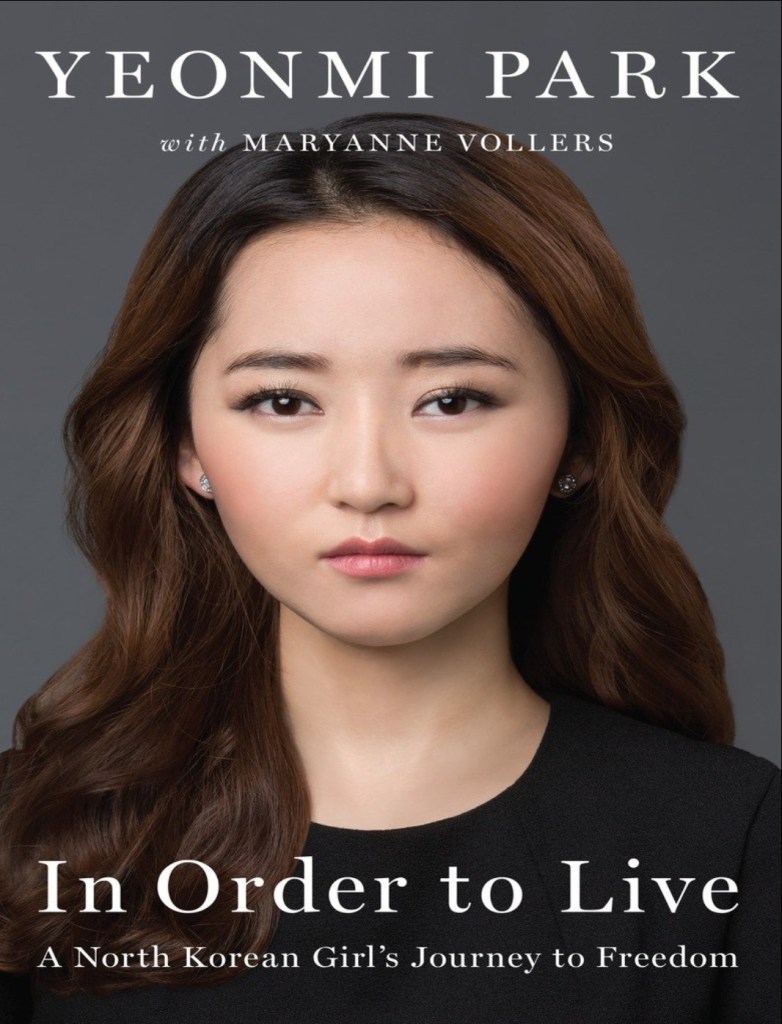
Source: https://ia800209.us.archive.org/33/items/while-time-remains-yeonmi-park/_In_Order_to_Live_-_Yeonmi_Park.pdf

She often contrasts the individual with the collective. She maintains that she grew up learning a regulated language, from which a manipulative dictator had censored ideas deemed to be criminal. Although languages are generally assumed to evolve according to something like “natural” laws of linguistics, such evolutionary developments can perhaps be interfered with (and maybe even interrupted) for short periods of time by some outside force — such as the enforcement of weird, cruel and unusual punishment in the context of an extreme dictatorship.

However, since such extreme conditions are so rare, my hunch is that such speculation is hardly based on adequate amounts of reliable or valid observational data. Nonetheless, I have long held natural languages to be far more reliable than idiosyncratic and strongly regulated expressions (usually “protected” and enforced by rule of law — for more about this, see “Rational Language” [ https://phlat.design.blog/2024/01/14/rational-media ] ).

In this vein, Yeonmi Park can be viewed as behaving rationally, preferring to participate in linguistic communities based on natural language rather than succumbing to the enforcement of dictatorial government regulations. In this light her behavior is seen by many as ideal and naturally beautiful, much in the same way as many natural phenomena which are interpreted as healthy and well adapted are normally perceived as appealing to most living things.

The WordPress Community: “Where we currently are, and where we are heading to”

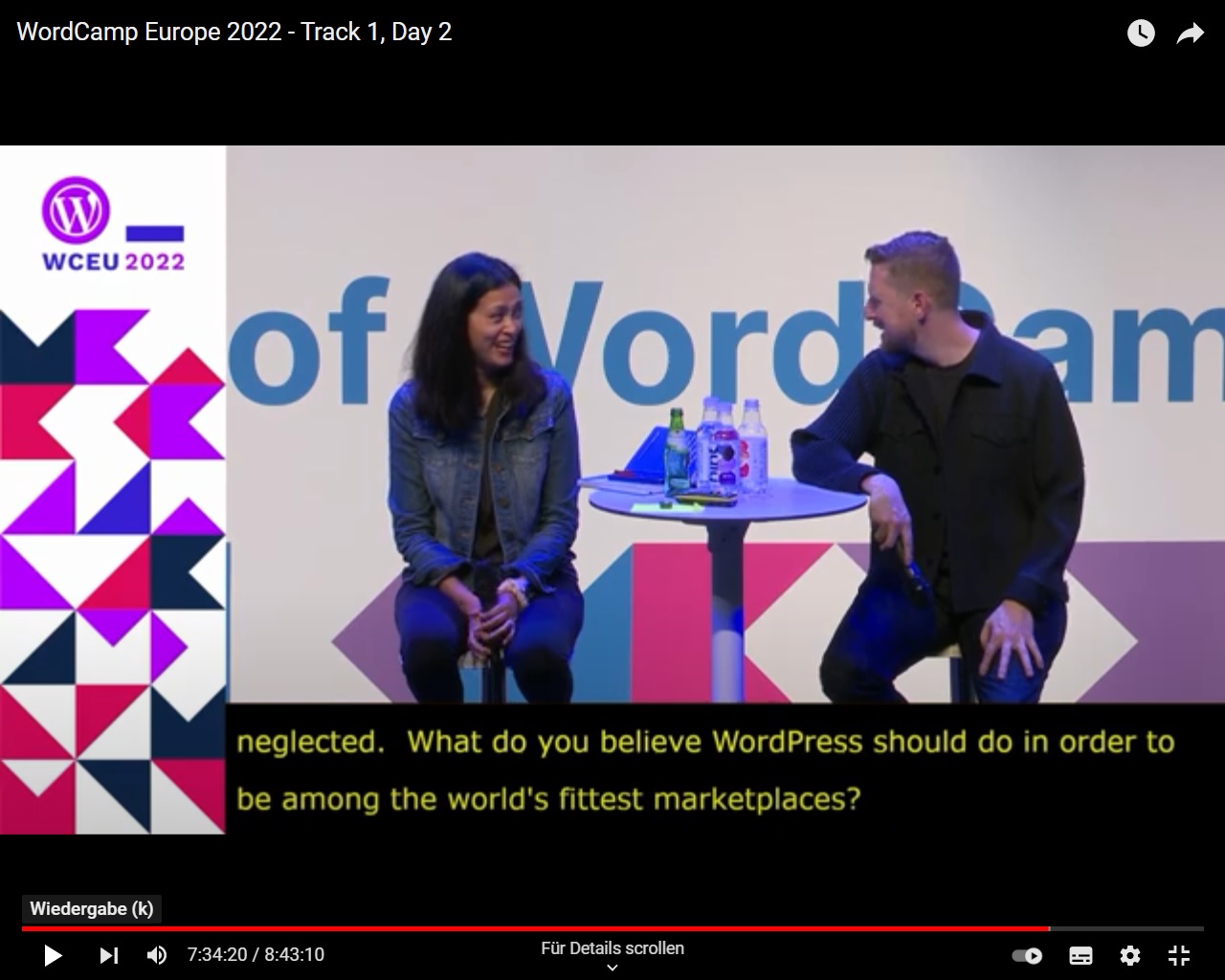
That quote is from a talk Alain Schlesser [ https://www.alainschlesser.com ] gave at WordCamp Europe (WCEU) a few weeks ago in Porto (yet which I didn’t have a chance to attend “in the flesh”). I myself did not give a presentation, but I did ask Matt Mullenweg and Josepha Haden a question (see e.g. “Social Business Regulation: Introduction & Socio BIZ Rule #1” [ https://socio.business.blog/2022/06/06/social-business-regulation-introduction-socio-biz-rule-1 ] ). Alain’s talk can already be viewed at WordPress.TV [ https://wordpress.tv/2022/06/24/we-need-to-do-better-really ], but my question to Matt and Josepha is not available yet in video format at that site (however, you can see an image including an excerpt from my question here):

What do you believe WordPress should do in order to be among the world’s fittest marketplaces? [@ search.tech.blog]

I think I view the situation even more gravely than Alain. In my opinion, publishing — which has been one of the cornerstones of modern science for about half a millennium — is currently at risk of being subsumed among a very few very large companies. These global players (including Google, Amazon and perhaps a few more businesses involved in what I might refer to as “Spyware 2.0”) are now already able to manipulate the global population — which now show an extremely naive kind of blind faith (I myself have referred to Google as the “online Pope” for well over a decade).

Alain details many reasons why many people have become “unwilling or unable” to use the open Web (versus “native” Apps — and here, oddly, “native” refers to the hardware platforms of the smartphones they are using [1] ).

His entire talk is very informative and I feel it also simplifies very complex issues just enough to make it easily understandable for the wider community — and it is this issue, namely the wider community that I wish to focus on here.

He concludes with a rather simple (and at the same time important) question: There’s got to be a better way of turning the value you’re producing into the money you need to make it sustainable — what are some proposals for such a better way? [2]

I have such a proposal

I propose that WordPress should focus more attention towards the integration of “the wider community” as participants (and as contributors, in a wide variety of roles) than it currently does. I believe this would mean that the WordPress project should devote far more attention into turning “walled gardens” into more fluid marketplaces with more permeable membranes. I believe this is very much in line with the question I raised (which I have also written about quite extensively — a good starting point being the article I shared above [via socio.biz] ). Obviously, there are security issues involved — and I strongly believe WordPress needs to step up its game in order to provide the wider audience with a justifiably stronger sense of security.

As one example of this, let me consider the role of “administrators” — the people keeping a WordPress site up and running from a “technological” perspective. Perhaps site owners would have a (justifiably) greater sense of security if they could “hand over the keys” to their site towards trusted (and as I argued in “Socio Biz Rule #1”: authenticated) partners — even more-so if they had different key for each of the different administrator types — such as web-designers, graphic-designers, database specialists, etc. — and likewise differentiated roles (and capabilities).

Community and teamwork belong on the same page — and this is true from the top levels all the way down to a participant who can do little or nothing more than to read or click a like button. In order for this to work, there needs to be a reliable way to discriminate between human beings and bots (again, simply as an example). I don’t mean 100% reliability, but I do mean reliable enough to guarantee that if an error happens, then it can be fixed in some way … to the satisfaction of each and every community participant.

[1] when you view my question @ WordPress.TV (I will update with a link as soon as it becomes available [ https://wordpress.tv/2022/07/17/matt-mullenweg-josepha-haden-in-conversation ] ), you will perhaps note that our discussion (@ ca. 21:30) also involves references these “open” versus “closed” (i.e. proprietary) platforms — you might also associate this with the “marketplace” versus the “cathedral” (a now widespread metaphor)
[2] note that I do not think money is a requirement — see also “Markets Without Money

Propaganda Information Technology vs. Indigena Information Technology — the Basic Idea

Let’s begin with information technology: All languages are infomation technologies, but not every information technology is a language. To qualify as a language, an information technology must be shared (in a free and open manner) among a community of users. Any and all aspirations to make an information technology proprietary immediately disqualifies it as a language. This is the case, for example, among registered trademarks, secret codes and such.

Now let’s turn to languages, in particular Latin. Indigena and propaganda are long-standing concepts based in the Latin language. They are basically opposites. Indigena (from “endo-” + “genus”) means inborn (either as adjective or as a noun). Propaganda is a term from the point of view of the propagandist — meaning essentially to propagate something (such as Christianity) in another environment (from its own native environment). In a zero-sum world, concepts are either native (indigena) or foreign (propaganda). That is all fine in a logical or mathematical manner, but reality is rarely so clear-cut.

Societies can be rather open or closed — and when they are more open, ideas can cross borders quite freely and easily. Such cross-pollination is generally seen as mutually beneficial, both in the natural world and also in the world of ideas. The expectation is that evolution will over time shape natural languages much in the same way it shapes species via the process referred to as “survival of the fittest”. Once you realize that since fittest refers to environmental conditions, and also that since nearly everything else is also evolving concurrently, the complexity of the systems involved increases dramatically as feedback loops upon feedback loops make for extremely loopy situations.

So while the indigena concept has rather fuzzy boundaries — starting right from the way “mother tongues” are not actually passed on in a genetic manner, but generally rather via involvement of close (but not fully identical) relatives … all the way to how languages are abstract and how they can transcend regional boundaries likewise freely and easily — the propaganda concept is nonetheless clearly different, insofar as it is a one-sided affair rather than mutually agreed upon. If done artfully, it may be successful in an enticing and seductive manner, fooling the sucker into believing they themselves choose to get on board.

All propaganda needs to be effective is a sufficient supply of suckers. Perhaps not every single one of Pavlov’s dogs behaved in the “Pavlovian” manner, but apparently enough did. And through the wonders of mesmerizing technology and ample amounts of legalese documentation and fine print, the trick of getting enough suckers to sign up for free offers is as easy as offering sweet candy to babes.

Among an out-of-sight-out-of-mind generation it is also a piece of cake to maintain propaganda communications at near-zero cost. The vast majority of suckers do not realize that they are being spied on around the clock, and that the communications they themselves believe to be clear and unadulterated are so adulterated that you would think it ought to be unlawful [ https://socio.business.blog/2022/05/07/the-law-one ].

Life Undrugged: Getting off online without all that greedy grid junk

So far, this is only an idea. Please feel free to contribute some comments and / or ideas of your own! 😀

The basic concept goes like this: We the people … don’t need no information pushed into our brains from any outside source. We already have everything we need. We just want to communicate with each other, in our own language, as natives, because we are made this way. We are humans, we use languages, we want to understand each other, we want to communicate.

Native communication doesn’t need any propaganda, ads, or similar BS technology. We just want to talk using regular language, thank you very much.

That said, there are indeed still some unresolved issues — such as:

  • is our community local or global?
  • do we use one language or many languages?
  • how do we respect diverse situations and contexts?

That is just a start. In general, this is a complex can of worms. Does that inspire you or intimidate you? Maybe both? Will you remain humble, or will you overcome any of your humility and be courageous enough to dare to know, dare to think, dare to believe, speculate, experiment, explore, whatever?

Yes? Start here & now! 😀